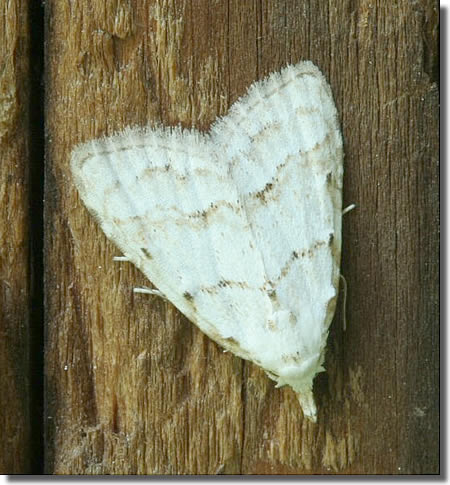
Photo © David G Green
Scarce Black Arches
Nola aerugula
Checklist Number74.005 [B&F: 2079]
Verification
Record will require further evidence, at least a good photograph, unless CMR is aware recorder has confidence in identification
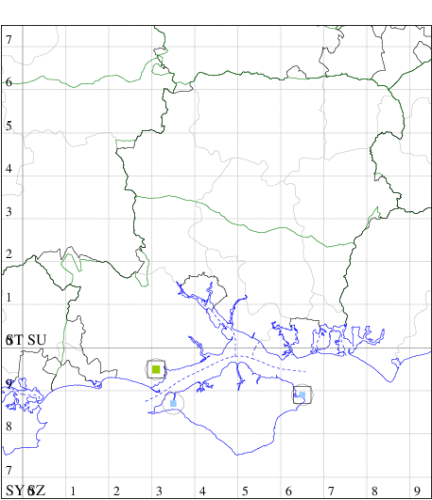
Resident in Kent from 1858-1898, and given it is reasonably frequent on the near continent, a candidate for future re-colonisation. As it currently stands, an immigrant from northern Europe, mostly appearing on the coasts of eastern and south-eastern England from Dorset to Yorkshire (in 2018, 19 individuals were recorded). In our area surprisingly there are only historical references, treated with caution by Goater in his 1974 county atlas, as follows: "The record...of a single specimen at light at Bembridge on July 1 1858 is quoted from Edw. Newman in British Moths: 25, who states that Mr C O Standish is reported to have taken a second specimen. It was also recorded from Freshwater (Tugwell, 1872, Entom. 6: 317) J H Fowler reported one from Ringwood (Hampshire) in 1892 (1893, Entom. 26: 126)." BG went on to say that he "preferred to remain open minded about the Isle of Wight specimens which are not, as far as I am aware, preserved in any collection. Its presence at Ringwood seems unlikely, and until a genuine Hampshire mainland specimen is demonstrated, is probably best regarded as a case of mistaken identity." None of these records were included in the Moths of Hampshire and Isle of Wight, 2001 (Goater and Norriss). Wingspan 15-20 mm. The most likely confusion species is Kent Black Arches Meganola albula. Larva feeds on Common Bird's-foot Trefoil, Red Clover, White Clover and Hare's-foot Clover.
The abundance in each month is indicated as follows:
 No records
 Very occasional
 Irregular
 Uncommon
 Off-peak, but not unusual
 Off-peak, but not unusual
 Main flight time
| J | F | M | A | M | J | J | A | S | O | N | D | |
|---|---|---|---|---|---|---|---|---|---|---|---|---|
| Adult | | | | | | | | | | | | |
| Larval | | | | | | | | | | | | |
Records by week (adult)
Records by week (larval)
VC10 Isle of Wight
| Site | Date | Quantity | Recorder | Stage |
|---|---|---|---|---|
| Bembridge (SZ68) | 01/07/1858 | one | C O Standish | Adult |
| Freshwater (SZ38) | 1872 | - | Tugwell | Adult |
VC11 South Hampshire
| Site | Date | Quantity | Recorder | Stage |
|---|---|---|---|---|
| Pennington (SZ39) | 25/06/2019 | one | Richard Coomber | Adult |