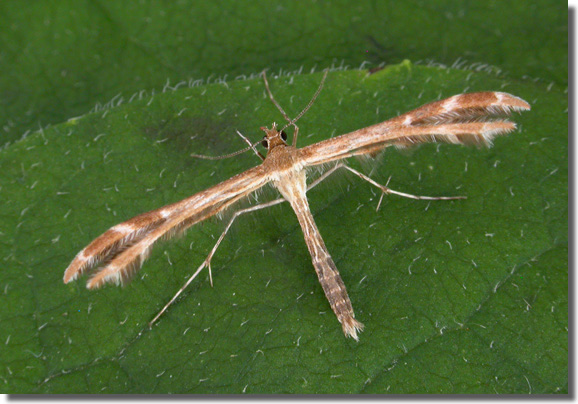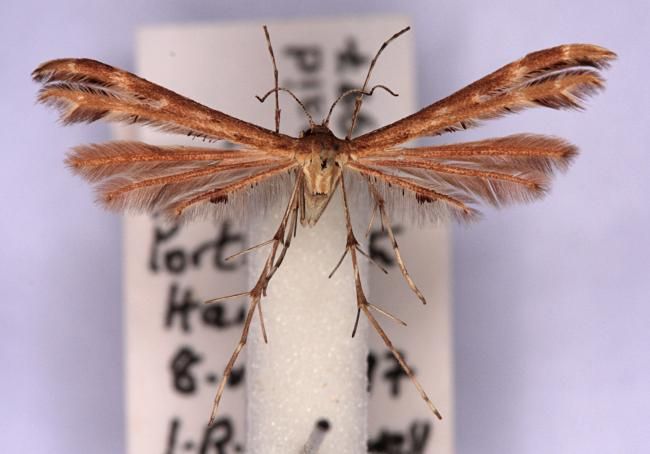
Photo © Mike Wall
Breckland Plume
Oxyptilus distans
Checklist Number45.026 [B&F: 1491]
Verification
Record will normally be accepted but photo evidence may be required - check with CMR if not sure of identity
Classification
| Family: | Pterophoridae |
| Subfamily: | Pterophorinae |
| Genus: | Oxyptilus |
| Species: | distans |
| Authority: | (Zeller, 1847) |
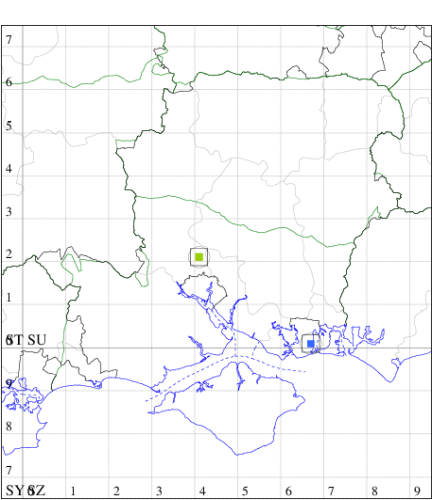
Nationally scarce (Nb) on heathland, chalk downland and sand-dunes throughout much of southern England. In Hampshire, two likely migrant specimens are know, the first recorded at Southsea on 8 August 1997, originally thought to be O. laetus but re-determined on dissection, and a second taken at light in Chandlers Ford in 2018. Not recorded from the Isle of Wight to date. Wingspan 15-22 mm. Can be separated from O. laetus only by dissection of the genitalia. Larva feeds on Mouse-ear Hawkweed, Marsh Hawk's-beard and Smooth Hawk's-beard, living within a spinning.
The abundance in each month is indicated as follows:
 No records
 Very occasional
 Irregular
 Uncommon
 Off-peak, but not unusual
 Off-peak, but not unusual
 Main flight time
| J | F | M | A | M | J | J | A | S | O | N | D | |
|---|---|---|---|---|---|---|---|---|---|---|---|---|
| Adult | | | | | | | | | | | | |
| Larval | | | | | | | | | | | | |
Records by week (adult)
Records by week (larval)
VC11 South Hampshire
| Site | Date | Quantity | Recorder | Stage |
|---|---|---|---|---|
| Portsmouth (SU60) | 08/08/1997 | one | Ian Thirlwell | Adult |
| Chandlers Ford (SU42) | 25/07/2018 | one | Brian Elliott | Adult |