Photo © Tony Davis
Coleophora calycotomella
Checklist Number37.037 [B&F: 0521a]
Verification
Record requires retention of specimen until confirmed, and may require dissection. Consult with CMR if unsure
Classification
| Family: | Coleophoridae |
| Subfamily: | Coleophorinae |
| Genus: | Coleophora |
| Species: | calycotomella |
| Authority: | Stainton, 1869 |
A species of southern Europe, first observed in the British Isles in 2004 and confirmed during 2007 as a resident in Surrey. The moth is single brooded flying from May to July, feeding on Cytisus scoparius in the UK but other foodplants of the Fabaceae have been recorded in Europe. The larvae feed on the stem and leaves from a mobile case constructed of the leaves of the foodplant and overwinter in the case attached to the foodplant.
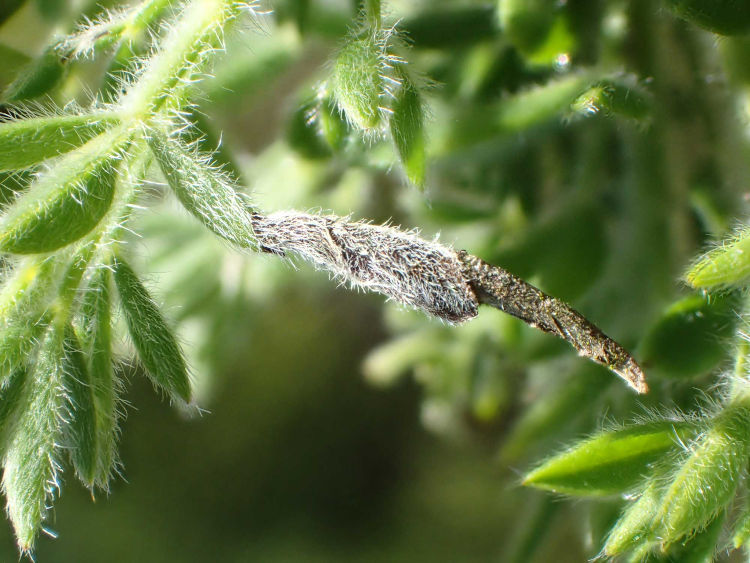
The adult moth has a variable wing colour from pale yellowish to dark blackish ochre, with white and prominent longitudinal stripes. The antennae are white. Identification by genitalia dissection will be required for acceptance. The larval case is constructed from leaves of the foodplant. The most recent additions (at the front) to the case will become dark and the earliest additions will fade to white. The case is laterally flattened with a gentle curve and slender up to 18mm. The oral opening is set at an angle of approximately 30 degrees, There is a characteristic feeding damage pattern on the stems of the foodplant. Wingspan 11.5-15 mm. Larva mines leaves of Thorny Broom and Broom in its native range.
The adult moth has a variable wing colour from pale yellowish to dark blackish ochre, with white and prominent longitudinal stripes. The antennae are white. Identification by genitalia dissection will be required for acceptance. The larval case is constructed from leaves of the foodplant. The most recent additions (at the front) to the case will become dark and the earliest additions will fade to white. The case is laterally flattened with a gentle curve and slender up to 18mm. The oral opening is set at an angle of approximately 30 degrees, There is a characteristic feeding damage pattern on the stems of the foodplant. Wingspan 11.5-15 mm. Larva mines leaves of Thorny Broom and Broom in its native range.