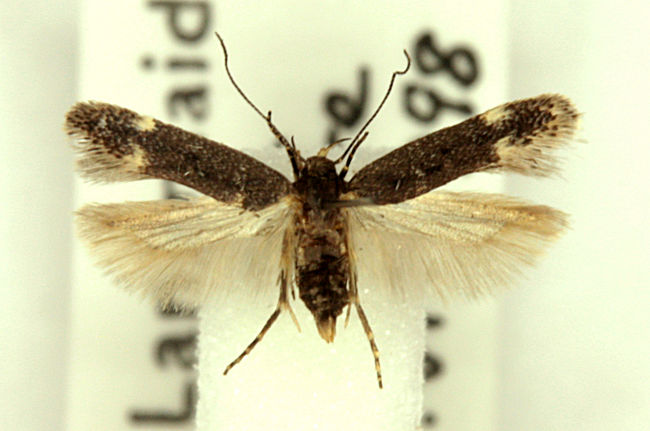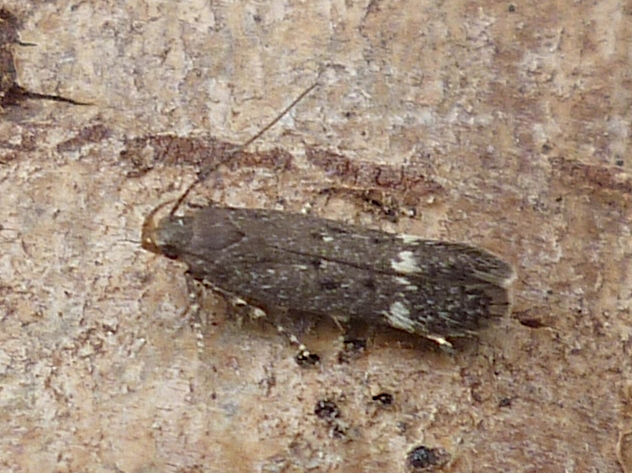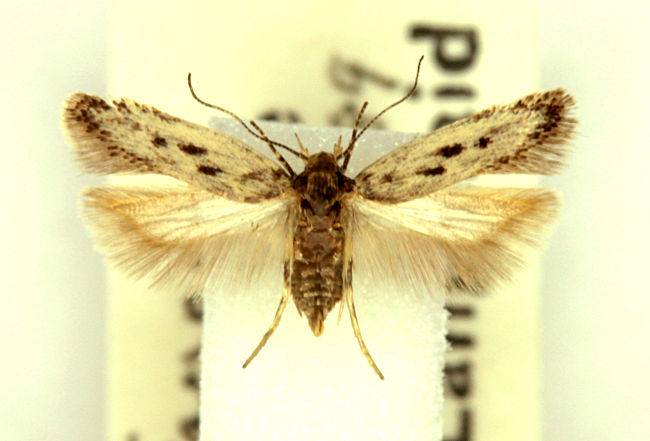
Photo © Mike Wall
Bryotropha umbrosella
Checklist Number35.048 [B&F: 0778]
Verification
Record will require further evidence, at least a good photograph, unless CMR is aware recorder has confidence in identification
Classification
| Family: | Gelechiidae |
| Subfamily: | Anomologinae |
| Genus: | Bryotropha |
| Species: | umbrosella |
| Authority: | (Zeller, 1839) |
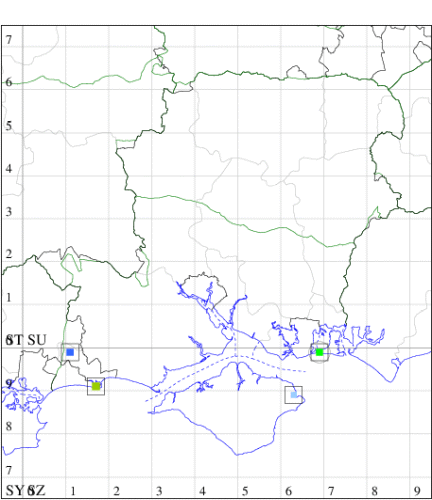
Nationally scarce (Nb) on coastal sand-dunes and, rarely, dry sandy areas inland throughout much of the British Isles, but absent from western Scotland, the Inner and Outer Hebrides, Orkney and Shetland. Under B. mundella, Goater (1974) states that in Hampshire this species was historically declared to have been 'abundant on coast sandhills' in the Victorian Natural History of 1900, and present at St Helens on the Isle of Wight (A Guide to the Natural History of the Isle of Wight, 1909). Despite this historical reference, Goater's 1992 supplement declares a record from Hayling Island in 1979 to be a vice-county record, so presumably the turn of the century report was deemed to be unreliable; it was re-found at Sinah Point, Hayling Island in 2005. In the Bournemouth area (VC11) it has been reported from Merritown Heath in 1993 and Hengistbury Head in 2013. There have been no modern day records from the Isle of Wight. Wingspan 9-11 mm. Differs from the other black species B. affinis and B. similis by the conspicuous clear white costal and tornal patches contrasting with the very dark forewing (MBGBI Vol 4 part 2). Larva feeds on various mosses and various grasses, living within a silken tube or tent.
The abundance in each month is indicated as follows:
 No records
 Very occasional
 Irregular
 Uncommon
 Off-peak, but not unusual
 Off-peak, but not unusual
 Main flight time
| J | F | M | A | M | J | J | A | S | O | N | D | |
|---|---|---|---|---|---|---|---|---|---|---|---|---|
| Adult | | | | | | | | | | | | |
| Larval | | | | | | | | | | | | |
Records by week (adult)
Records by week (larval)
VC10 Isle of Wight
| Site | Date | Quantity | Recorder | Stage |
|---|---|---|---|---|
| St Helens (SZ68) | 1884 | - | IWG | Adult |
VC11 South Hampshire
| Site | Date | Quantity | Recorder | Stage |
|---|---|---|---|---|
| Merritown Heath (SZ19) | 26/07/1993 | - | J R Langmaid, R J Heckford, P H Sterling | Adult |
| Sinah Common, Hayling (SZ69) | 20/07/2005 | - | John W Phillips, Brian Elliott | Adult |
| Sinah Common, Hayling (SZ69) | 20/07/2005 | - | John W Phillips, Brian Elliott | Adult |
| Hengistbury Head (SZ19) | 29/06/2013 | - | Mike Jeffes | Adult |