Trifurcula beirnei
Checklist Number04.069 [B&F: 0047]
Verification
Record requires retention of specimen until confirmed, and may require dissection. Consult with CMR if unsure
Classification
| Family: | Nepticulidae |
| Subfamily: | Nepticulinae |
| Genus: | Trifurcula |
| Species: | beirnei |
| Authority: | Puplesis, 1984 |
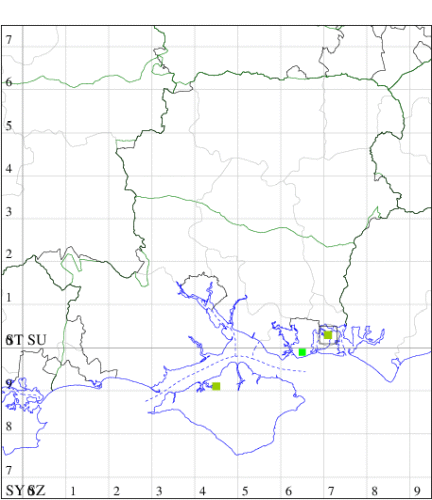
Rare and thinly distributed in England, but sometimes numerous where it occurs. First added to the Hampshire list on the basis of AM Emmet's account in Ent Rec J Var 98: 134: "Recently S N A Jacobs gave me a box of unidentified Nepticulidae which included a few taken by the late W Fassnidge. Amongst (these) was a specimen of T. beirnei captured at Southampton on 20th August 1935. This seems to be the most recent British record..." Fassnidge's "Southampton" was a very vague term for the district, and not necessarily the actual city, so the location of capture is unknown for this and many other specimens in his collection. In Hampshire it has been found to be reasonably common at Stoke, and at Hayling Billy, on Hayling Island: also once to light in Southsea, close enough to perhaps represent a wandering individual from Hayling. The sole Isle of Wight record is of one determined from an adult captured at light in the north of the island in 2016. Wingspan 8-9 mm. The life history is still a mystery: according to Nieukerken et al. (2010), probable food plants lie in the genus Genista but mines and caterpillars are still unknown: Emmet (loc. cit.) states that the moth flies in grassy areas where G. tinctoria grows, which would corroborate.
The abundance in each month is indicated as follows:
 No records
 Very occasional
 Irregular
 Uncommon
 Off-peak, but not unusual
 Off-peak, but not unusual
 Main flight time
| J | F | M | A | M | J | J | A | S | O | N | D | |
|---|---|---|---|---|---|---|---|---|---|---|---|---|
| Adult | | | | | | | | | | | | |
| Larval | | | | | | | | | | | | |
Records by week (adult)
Records by week (larval)
VC10 Isle of Wight
| Site | Date | Quantity | Recorder | Stage |
|---|---|---|---|---|
| Jersey Camp (SZ49) | 29/07/2016 | one | Ian Merrifield | Adult |
VC11 South Hampshire
| Site | Date | Quantity | Recorder | Stage |
|---|---|---|---|---|
| Southampton (SU30) | 20/08/1935 | - | W Fassnidge | - |
| Southsea (SZ69) | 20/08/2000 | one | John R Langmaid | Adult |
| Hayling (SU70) | 30/08/2002 | one | J R Langmaid, B Elliott | Adult |
| Hayling (SU70) | 02/09/2002 | three | J R Langmaid, B Elliott | Adult |
| Hayling (SU70) | 23/08/2003 | - | J R Langmaid, B Elliott | Adult |
| Hayling Billy (SU70) | 22/08/2011 | one | Tony Davis | Adult |